reading sample
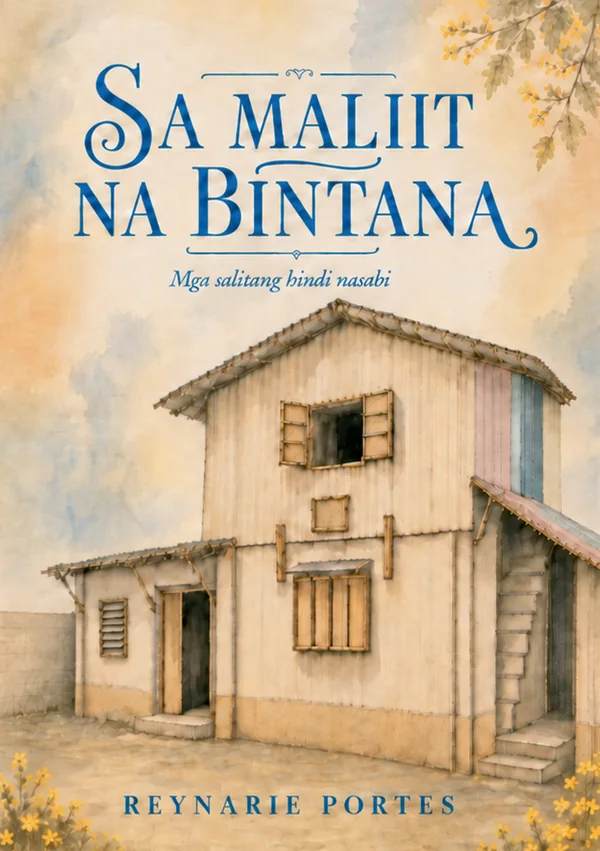
Sa Maliit na Bintana
The first two chapters
Chapters one and two in full — in the original Filipino, and in English and German translation.
The book is out in Filipino. An English edition is in preparation; a German one is planned after that.
Chapter 1
Three Shadows in the Moonlight
The moon was full the night Polay first saw the three girls. It was the school holidays, and she was playing in front of their house with her playmates.
Everything around them was bright, but there was a stretch of road the light did not reach. That was where they appeared — three figures walking together from the direction of the barangay hall towards Judge Rodriguez’s house.
Polay and her friends stopped playing.
“Who are they?” Margie asked quietly.
No one answered.
Their faces were unfamiliar. They were neatly dressed, unlike the other children who had long been at home on the dusty road, in games of chase under the moon, and in shouting that carried all the way to the next purok. To Polay, the newcomers looked serious. Hard to approach. As though they did not know how to play.
The three girls walked straight on to the main gate of the wide yard. No one greeted them, and they greeted no one. Plainly they knew nobody in Polay’s group.
After a while a group of boys cut into the conversation.
“They say those are Judge Rodriguez’s grandchildren. They come from Manila, and they’re cousins of Nonoy and Maymay,” one of them said.
Polay and the others already knew Nonoy and Maymay; they had played together for years.
Polay said nothing. She only watched in silence and listened to what her playmates were saying. She followed the three girls with her eyes until they had gone into the yard and on into the house.
In their small barangay the news travelled quickly among the children. By the next day almost everyone knew the rest. There were five siblings from Manila, they said, and they had moved into the house Judge Rodriguez had left behind. Their mother was in Manila for work, so it was the father who stayed with the children.
The eldest was Arnie, and after him came Dina.
Then there were Jamich, Olivia, and Agatha, the youngest. In the days that followed, Polay would also come to know the other siblings and the relatives who came and went at the house.
That night the moon lit only part of the three girls’ faces as they walked through the dark. Polay did not yet know which of them would be the easiest to befriend.
Nor did she know which one would be the hardest to forget.
Chapter 2
The House on the Right
Standing in front of Polay’s house, you could see the little church to the left. Every Saturday it filled with neatly dressed families and with children being hushed as the service began.
Right beside Polay’s house lay the large yard that held two houses. From the big gate you looked straight at the house where the late Judge Rodriguez had lived. At the far right stood the house of Nonoy and Maymay, which had its own path in. No fence divided the middle; the two houses shared one wide yard. Later, a family from Manila moved into the judge’s former home.
While the judge was still alive their house was quiet, with few children coming and going. But they kept many dogs, and the dogs barked and barked whenever Polay passed the gate. Polay knew one of the judge’s grandchildren. Whenever the child was there, she would often see him going in and out of the gate. Now and then he came to visit with his mother, who often had her nails done by Polay’s mother.
Polay could no longer remember the real name of the judge’s wife. Everyone simply called her Ma’am. But one thing about her stayed clear in her memory: the padyak and the peso coins.
When the children saw Ma’am climbing down from the padyak, they quickly gathered at the side of the road. They did not have to ask. She would often open her purse and give each of them a peso.
In a child’s hand, one peso was a great deal. It could become sweets, a packet of crisps, or a stake in a game that needed coins. Whenever Ma’am arrived, children who had been quarrelling a moment before suddenly turned polite and, one by one, took her hand to their foreheads.
On the day of Judge Rodriguez’s funeral, their house filled with people. Many came to pay their respects and to talk. Some arrived whom Polay did not know.
Polay happened to be going from house to house that day, selling banana cue. Because she had not sold them all, she offered them to the people outside the Rodriguezes’ house. While Ma’am was outside talking to someone, Polay slipped in to ask whether she would like to buy one.
“Oh, no, thank you,” Ma’am answered gently, and smiled at her.
Polay’s parents saw her offering and told her off for it. She did not know then that this would be their last short conversation. It was also the last time she saw Ma’am face to face.
The house fell silent — until the family from Manila came to live there.
Next to the Rodriguezes’ large yard stood Polay’s small house. It was made of wood and roofed with nipa. Small as it was, it had an upper and a lower floor; the lower part served as the silong. At night they lit a gasera, because they had no electricity. Whenever it was time to cook, thick, choking smoke swallowed the inside of the house.
In the yard grew an eba tree. Its fruit was terribly sour, ripe or unripe, but good dipped in salt. They often used it to sour their cooking as well. There was a guyabano tree too, heavy with fruit. Off to one side stood the old bicycle and the padyak, its seat still made of hard wood.
Along the edge of their path, a plant they called buyo crept up the wall. To Polay’s family it was something close to a miracle. Whenever one of them had a fever, a headache, or a pain somewhere in the body, they picked buyo leaves and warmed them over the gasera. While the leaves were still warm they pressed them to the forehead, or to the place that hurt.
Because of this they no longer bought medicine at the shop. In a family that had to divide every coin, money that would have gone to medicine could be added to the food instead. In Polay’s memory the buyo worked, and it helped them more than she could say.
Behind the barangay stood the large elementary school. Its grounds were broad and flat, so a helicopter could land there safely. Whenever a helicopter came down, Polay and her friends could hardly contain themselves. They slipped through a gap in the fence that served as a shortcut and raced one another to the school.
Many of Polay’s happiest memories with her friends took place at that school. It was close to their house, but being close was no guarantee that schooling would be easy for children like her.
In those years Polay was the third of six children and the only girl. Among her older brothers and her playmates she grew used to keeping up in running, climbing, shoving, and every other street game. To others she seemed almost boyish, but to her it was nothing unusual — it was how she kept up. She had also grown up watching her father teach karate around their town, so being quick, brave and a little tough was nothing new to her.
She was also the one most often told to look after their youngest brother. Later, another child would be born in Nagaria — another boy, the seventh child and the youngest in the family.
Her mother, Rose, went from house to house giving manicures and pedicures. She carried a small case of nail tools and set out wherever a customer called. Her father, Rodolfo, sold spices and vegetables at the palengke and had a sideline teaching karate in the different barangays of their town.
Early on, Polay saw how a small income was stretched, and how the coins earned in the morning were gone before evening. It was from Rodolfo that she learned to sell — not as a game, but as the way their family got by.
On Tuesday and Friday mornings, Polay liked to go with her father to the palengke. She was eager to help, but going so often was also why she missed classes.
After Rose explained their situation, the teachers chose to understand Polay rather than scold her. They admired her, too, because in spite of her absences she still came away with honours at school.
Because she got used to market life early, she also learned to count and to reckon. Mathematics became her favourite subject.
Charice and Jenny lived opposite the house of the former kapitana. They were sisters, and the former kapitana’s granddaughters. Polay often saw them inside her house when she hung about there to watch television with them.
To Polay’s eyes, Charice and Jenny were a little better off. Whenever she saw Charice eating pancit canton, she remembered how little their own family had. At home it was usually instant noodles cooked with plenty of broth — easier to stretch, to top up with water, and to divide among the children — or else lugaw: with sugar when they were lucky, with nothing but salt when they were not.
Even drinking a soft drink from a little plastic bag with a straw felt like luxury to Polay. When her parents bought one, they brought home a one-litre bottle and poured it into glasses so that everyone had a share. The chance to have her own bottle of Royal — a drink meant for her alone, which she did not have to divide — came only when she had a fever. As though she first had to fall ill before she could have something she could call entirely her own.
She was more than happy, too, when the meal was sardines and not only vegetables.
Life was not so different for Ivy and Margie. The two sisters lived in a small kubo on the next street, almost opposite the little church. Beside the church stood a great tree said to be inhabited by a kapre. They had no electricity or television either. Yet even in nearly the same hardship there were small differences. Ivy and Margie had a wardrobe and a proper cabinet for their clothes. In Polay’s house, cardboard boxes that had once held noodles and sardines served as the place where she and her brothers kept theirs.
Polay came to know poverty early, though back then she had no name for those differences. She saw them only in the food, in the way a soft drink was drunk, and in where the clothes were kept. But when it came to playing, all of it fell away for a while. In the running, the laughing, and in tumbang preso, it did not matter whose house had a wardrobe and whose clothes were in a box. Different as the homes they returned to were, they grew up together on the same road.
They were usually together. Now and then the group grew — when someone new rented from Chong Lolong and brought children along, or when Charice and Jenny’s cousin came home to the town for the holidays and joined their games. But it was still Ivy, Margie, Charice, Jenny and Polay who always found one another — until the family of Arnie and Dina arrived and, little by little, became part of the group as well.